


The most useful souvenir from dental treatment abroad may be the information that allows another clinician to understand what was done.
A "dental treatment passport" is not an official travel document or a universal clinical standard. It is a practical, patient-held summary of treatment, materials, implant components, records, aftercare and emergency contacts.
It should support continuity of care without replacing the clinic's complete notes, radiographs, scans, consent records or laboratory information.
Ask for records before leaving
The easiest time to confirm missing information is while the patient, treating dentist and clinic records are in the same place.
Do not rely on a promise that documents will be sent later. Before travelling home, check that the files open, the images belong to the correct patient, dates and tooth positions are understandable and contact details work.
Where treatment is staged, obtain an updated passport after every visit rather than waiting until final completion.
Identify the patient, clinic and treating professionals
The summary should include:
- patient name and date of birth or another agreed identifier;
- clinic's legal name, address and contact details;
- treating dentist's name and professional registration details where applicable;
- names and roles of other responsible clinicians;
- treatment dates;
- a 24-hour or out-of-hours contact route;
- and the person authorised to communicate with another dentist.
A coordinator's details can be included, but the clinical contact should be identifiable separately.
Record what treatment was actually performed
The final record may differ from the original quotation. It should state what occurred, not only what was planned or sold.
Depending on the case, record:
- teeth retained, treated or removed;
- extraction dates and sites;
- implant placement dates and positions;
- grafting or sinus procedures;
- temporary restorations fitted;
- abutments or connection components used;
- final crowns, bridges, dentures or full-arch restorations;
- materials and frameworks;
- occlusal or bite adjustments;
- medicines prescribed;
- complications, changes or unfinished work;
- and the next planned stage.
Use recognised tooth notation and include a simple patient-readable description.
Implant details need more than a brand name
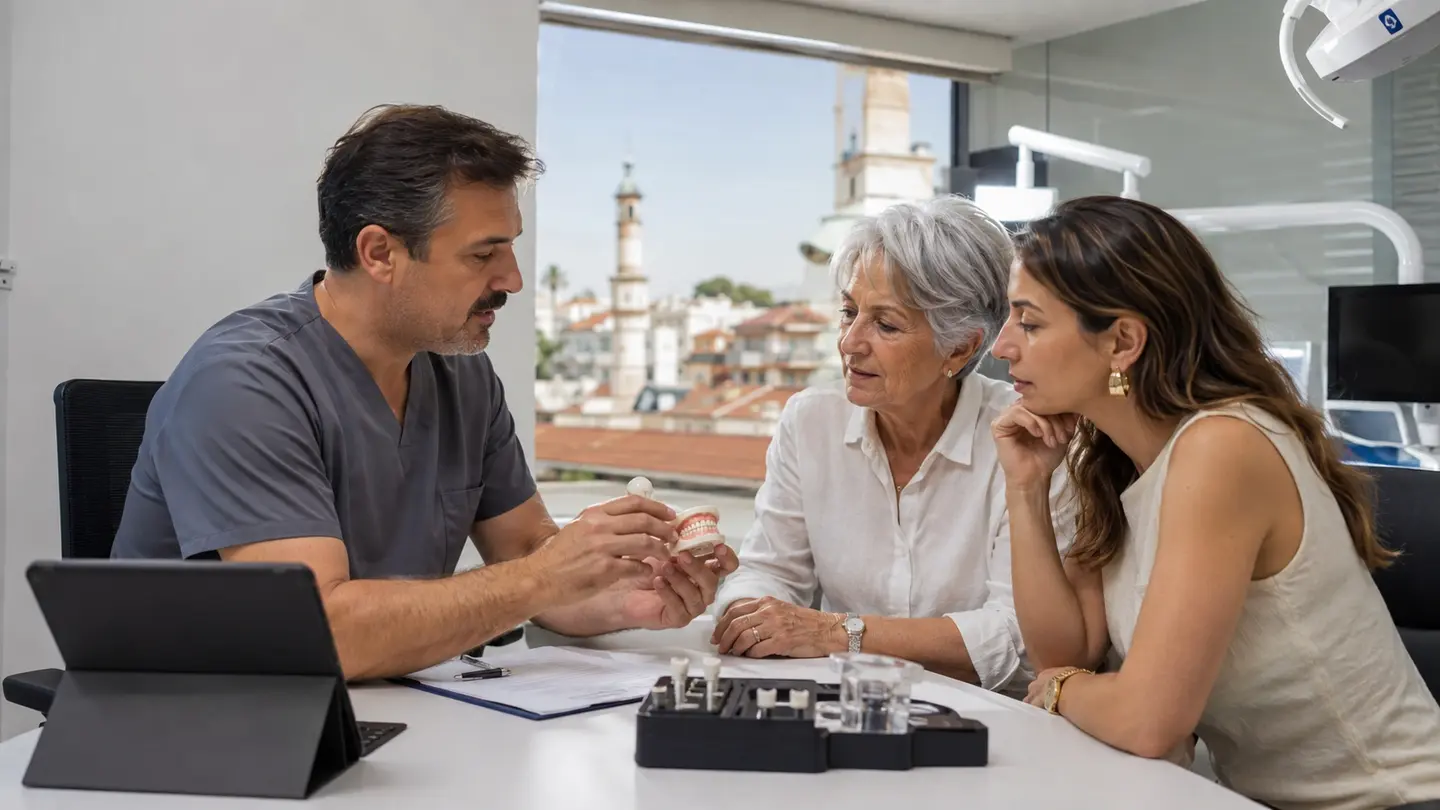
Another clinician may need to identify compatible components and instruments. For each implant, request:
- manufacturer;
- implant system or family;
- implant model;
- diameter and length;
- connection type where relevant;
- implant position;
- placement date;
- batch, lot or reference number where available;
- and details of the abutment and retaining screw.
Include the manufacturer's labels or traceability stickers if supplied. A photograph of a box is helpful only if the information is readable and clearly linked to the correct implant position.
Describe the restoration and how it is retained
The passport should help another dentist understand what sits above the implants.
Record:
- whether it is temporary, transitional or definitive;
- whether it is fixed or removable;
- whether it is screw-retained, cemented or attached another way;
- visible-tooth material;
- framework material;
- number and location of supporting implants;
- screw-access positions;
- relevant screw or component references;
- laboratory name and location;
- and the date fitted.
If a removal tool, driver or special protocol is required, this should be identified without encouraging the patient to adjust anything themselves.
Keep radiographs, scans and photographs in usable form
A printed screenshot is not equivalent to the original diagnostic file.
Ask for copies of relevant:
- panoramic and intraoral radiographs;
- cone-beam CT data where appropriate;
- digital scans or models;
- clinical photographs;
- laboratory records;
- and reports interpreting imaging where produced.
Request standard, usable digital formats and the software or viewer information needed to open specialist files. Retain the original acquisition date and do not edit or compress clinical images through messaging apps when avoidable.
Imaging should only be repeated when clinically justified by the assessing professional. Previous records may help avoid unnecessary duplication, but they do not determine whether new imaging is required.
Record post-operative and discharge instructions
The passport should link to the full personalised instructions and summarise:
- medicines and duration;
- eating and activity restrictions;
- cleaning instructions and recommended tools;
- temporary-restoration precautions;
- expected early effects;
- warning signs requiring contact;
- review dates;
- fitness-to-fly advice where given;
- and who should remove stitches or provide local follow-up.
Generic printed instructions should not replace directions specific to the patient's procedure and medical history.
Include the unresolved and conditional parts
A useful record states what is not yet known or completed.
Examples include:
- an implant that was planned but not placed;
- a site still healing;
- a temporary restoration awaiting replacement;
- a component that requires review;
- an outstanding laboratory stage;
- a pending test or radiograph;
- or a treatment decision deferred until the next visit.
This prevents the next clinician from mistaking a staged plan for completed treatment.
Add the aftercare and escalation pathway
The passport should identify:
- routine clinic contact;
- urgent and out-of-hours contact;
- the named dentist reviewing concerns;
- expected response times;
- a local follow-up provider if agreed;
- which local interventions are authorised;
- how records will be shared;
- and when return to the original clinic may be necessary.
Keep clinical escalation separate from complaints, insurance and guarantee claims.
Attach commercial documents without confusing them with records
Store copies of:
- final invoice and payment receipts;
- itemised treatment plan;
- consent documents;
- guarantee terms and exclusions;
- aftercare agreement;
- insurance correspondence;
- and travel or accommodation commitments made by the clinic.
These documents can establish what was agreed. They do not by themselves establish diagnosis, current clinical condition or the cause of a complication.
Translation must preserve clinical meaning
If records are not in a language the patient's local dentist can use, ask for a professional or clinic-authorised translation. Keep both the original and translated versions.
Product names, measurements, tooth positions and clinical terms should not be paraphrased casually. Ask the treating clinic to correct ambiguities before departure.
Protect sensitive information

Dental records and facial images are sensitive personal information. Store them securely, use protected sharing methods and check the recipient before sending.
Keep at least two accessible copies in different secure locations. A phone-only copy can become unavailable if the device is lost, damaged or locked. Avoid posting clinical records in public groups when asking for general support.
Rights to records and response times depend on the organisation and the law that applies to it. For a clinic in Türkiye, the Turkish Patient Rights Regulation (Article 16) gives patients the right to inspect their health records and obtain a copy, and the regulation on private oral and dental health facilities (Article 22) requires diagnosis and treatment records, including radiographic records, to be kept electronically. In the UK, individuals generally have a right to request copies of personal information from UK organisations holding it, but UK rules should not be assumed to apply to a clinic abroad. Ask the clinic in advance what records it will provide and how quickly.
The before-you-leave checklist
Before travelling home, confirm:
- I have the final record of what was actually done.
- Every implant position and component is identified.
- Temporary and definitive work is clearly distinguished.
- I have usable copies of relevant radiographs and scans.
- The files open on another device.
- Medicines and personalised instructions are documented.
- Unfinished or conditional treatment is listed.
- My next review date and provider are confirmed.
- I have urgent and out-of-hours contact details.
- A local dentist can contact the treating clinician.
- I have written aftercare and guarantee terms.
- Costs and authorisation for additional care are explained.
- I know which symptoms require urgent help.
- Records are translated where necessary.
- Secure backup copies exist.
A passport supports continuity; it does not certify success
A complete record makes communication easier and may help another clinician identify components, understand the sequence and decide what assessment is needed.
It does not prove that treatment is healthy, complete or suitable, and it does not authorise a patient to adjust implant components. Those decisions require professional assessment.
Important information
This article provides general educational information. The records required for an individual depend on the treatment, destination, provider and clinical circumstances.
Ask the treating clinician what must be included and show the information to the professional responsible for follow-up. Seek urgent care when symptoms require it rather than waiting for documents.
Dental Compass does not hold the clinic's complete clinical record, certify treatment or provide diagnosis.
Sources and further reading
- General Dental Council, Dental record keeping (opens in a new tab) — clinical records support continuity, diagnosis, treatment planning and assessment of concerns, for GDC-registered professionals.
- General Dental Council, Maintain and protect patients' information (opens in a new tab) — standards for GDC registrants on accurate, complete records and protection of clinical information. It does not govern overseas clinics generally.
- Information Commissioner's Office, Getting copies of your information (opens in a new tab) — UK guidance on requesting personal information from an organisation holding it. It should not be assumed to apply to a clinic abroad.
- NHS England, Getting copies of medical records (opens in a new tab) — UK NHS guidance that requests for copies of records are made to the organisation holding them, including a dentist; it concerns UK providers.
- General Dental Council, Direct access (opens in a new tab) — GDC guidance for registrants on accurate records and transfer of relevant clinical information, including radiographs, when referring.
- NHS, Treatment abroad checklist (opens in a new tab) — planning, provider information, risks and aftercare before overseas treatment.
- British Society of Periodontology, Patient FAQs — Dental Implants (opens in a new tab) — implant, abutment and restoration components; assessment, maintenance and possible complications.
- Republic of Türkiye Ministry of Health (hosted text), Hasta Hakları Yönetmeliği (Patient Rights Regulation) (opens in a new tab) — Article 16 on the patient's right to inspect health records and obtain a copy; checked 3 October 2026.
- Resmî Gazete, Ağız ve Diş Sağlığı Hizmeti Sunulan Özel Sağlık Kuruluşları Hakkında Yönetmelik (regulation on private oral and dental health facilities) (opens in a new tab) — Articles 22 and 23 on electronic patient records, including radiographic records, and on consent forms; checked 3 October 2026.