

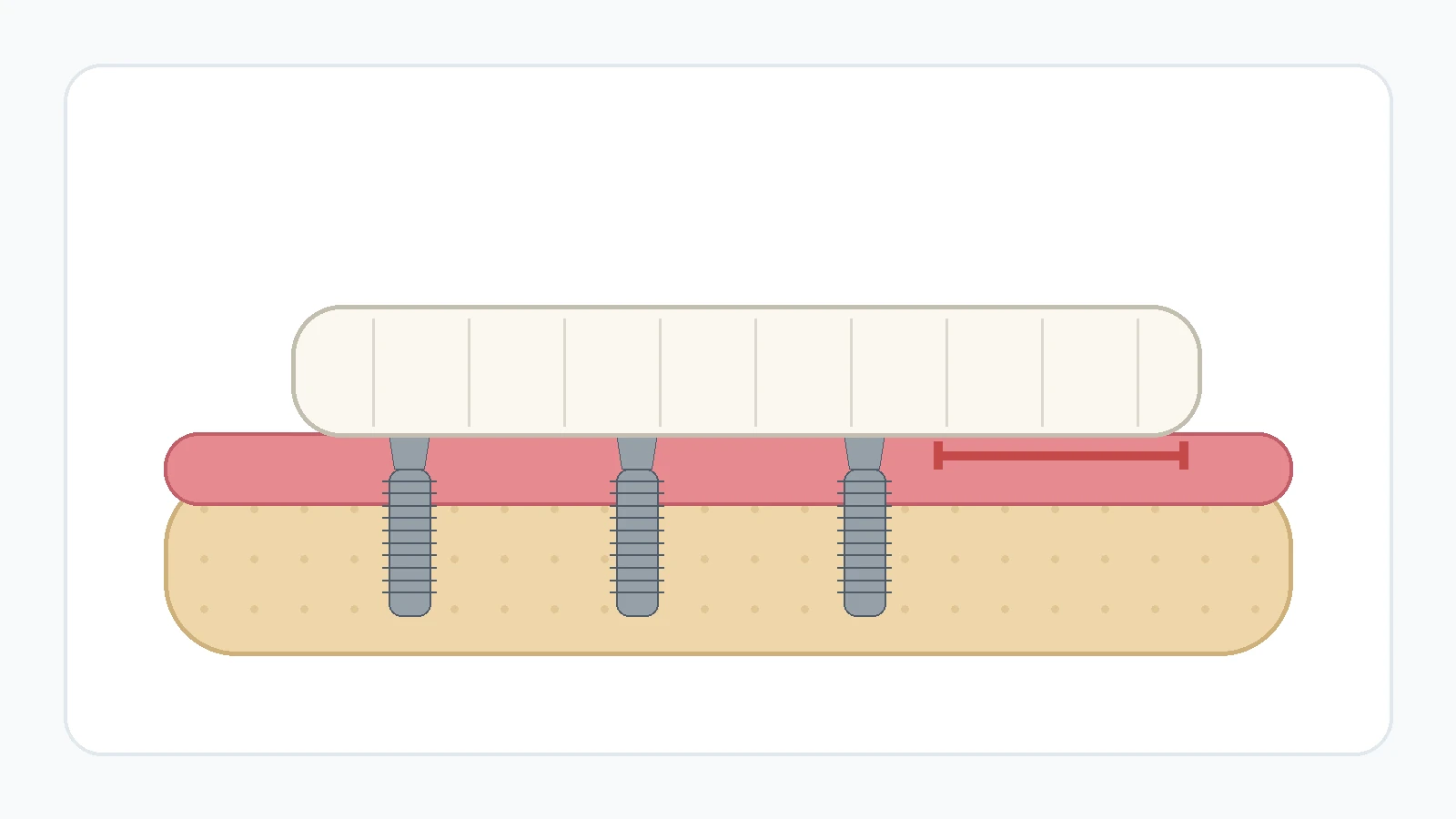
A cantilever is the part of a dental bridge that extends beyond the last supporting implant.
In other words, one end of that section is supported by the implant-supported bridge, while the outer end does not have another implant directly underneath it.
Why are cantilevers used?
Cantilevers can be used when placing another implant would be difficult, unnecessary or undesirable.
Reasons may include:
- limited bone in a particular area
- nearby nerves, sinuses or other anatomical structures
- insufficient space for another implant
- a treatment design intended to avoid additional surgery
- the need to replace an additional tooth without placing another implant
They are a recognised prosthetic design option, not automatically a defect.
Are cantilevers safe?
They can work successfully when appropriately planned.
However, cantilever length, bite forces, implant number and position, the type of tooth being replaced and the patient's habits all affect the design.
Cantilevers can increase mechanical demands on the restoration, so dentists consider risks such as screw loosening, chipping, fracture or other technical complications.
Are cantilevers used in full-arch bridges?
Yes.
Some full-arch implant bridges include short cantilevered sections beyond the most posterior implants.
This can allow the restoration to replace teeth farther back without placing implants close to anatomical structures or in areas with limited bone.
The appropriate length is a clinical and prosthetic design decision.
Does a longer cantilever mean more teeth?
Potentially, but adding length also changes the forces acting on the bridge and implants.
A longer extension is not automatically better.
The dentist and laboratory must balance appearance and function with the mechanical demands on the restoration.
Is a cantilever always visible?
Not necessarily.
From the patient's perspective, the cantilever may simply look like part of the bridge.
The term describes how that section is supported rather than how it looks.
Why might this matter when comparing treatment plans?
Two clinics may propose different implant positions or bridge lengths.
If one plan includes a cantilever and another does not, ask:
- why that design was chosen
- how far the bridge extends beyond the final implant
- whether the design affects the number of teeth being replaced
- whether alternative implant positions were considered
- how the bridge will be maintained and monitored
The aim is not to judge the design from one word alone, but to understand why it has been proposed.
In simple terms
A cantilever is a section of a dental bridge that extends beyond its last direct implant support.
It can be a deliberate part of implant bridge design, but its length and loading need to be planned carefully.