

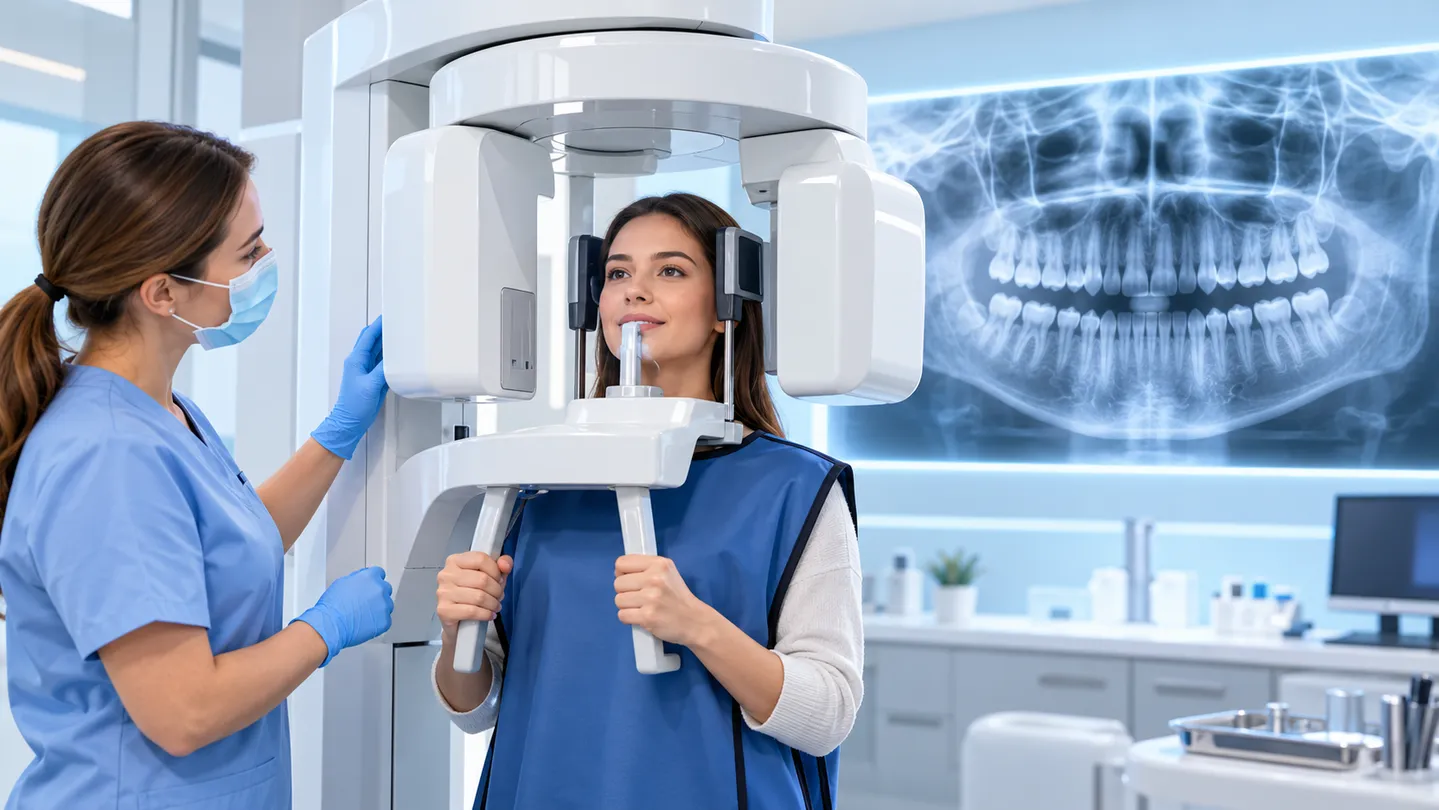
An OPG is a panoramic dental X-ray that shows the upper and lower jaws, teeth and surrounding structures in one broad two-dimensional image.
OPG stands for orthopantomogram.
It is commonly used as part of dental assessment and treatment planning.
What can an OPG show?
Depending on the reason for the X-ray, an OPG may help a dentist assess:
- the position of teeth
- missing teeth
- impacted teeth
- the general condition of the jawbone
- existing dental restorations
- some areas of infection or pathology
- wisdom teeth
- the broad position of important anatomical structures
- existing implants
It provides an overview rather than detailed three-dimensional information.
How is an OPG taken?
The patient usually stands or sits in the X-ray machine while the imaging unit rotates around the head.
You are asked to keep still and may be asked to bite gently on a positioning guide.
The exposure itself is quick.
Is an OPG painful?
No.
Nothing surgical is involved, and the imaging procedure itself should not be painful.
Is an OPG the same as a CBCT?
No.
An OPG is a two-dimensional panoramic image.
CBCT creates three-dimensional data that can be viewed in slices and reconstructed images.
A CBCT can provide more detailed information about bone dimensions and the relationship between structures, but it also involves a different imaging technique and generally a higher radiation dose than a standard panoramic image.
The dentist should select the imaging that is clinically justified.
Can an OPG be used for implant planning?
It can be part of an implant assessment.
An OPG can provide a broad overview of the jaws, existing teeth and anatomy.
However, for some implant decisions the dentist may need more detailed three-dimensional information from CBCT.
An OPG alone is not always sufficient for final implant planning.
Why do overseas clinics sometimes ask for an OPG before travel?
An OPG can give the clinic an initial overview of your dental condition before you attend.
It may help them prepare a provisional treatment discussion or estimate.
However, a remote plan based on an OPG can still change after clinical examination or more detailed imaging.
Does an OPG involve radiation?
Yes.
It uses X-rays and therefore involves ionising radiation.
As with other dental imaging, it should be taken when there is a clinical reason and the expected information justifies the exposure.
Why might an OPG appear on a dental quote?
Some clinics include panoramic imaging in consultation or package fees.
Others charge separately.
When comparing quotes, check whether the OPG, CBCT and any repeat imaging are included or separately priced.
In simple terms
An OPG is a panoramic two-dimensional X-ray showing both jaws and the teeth in one image.
It gives a useful overall view, but it is not the same as a three-dimensional CBCT scan.