

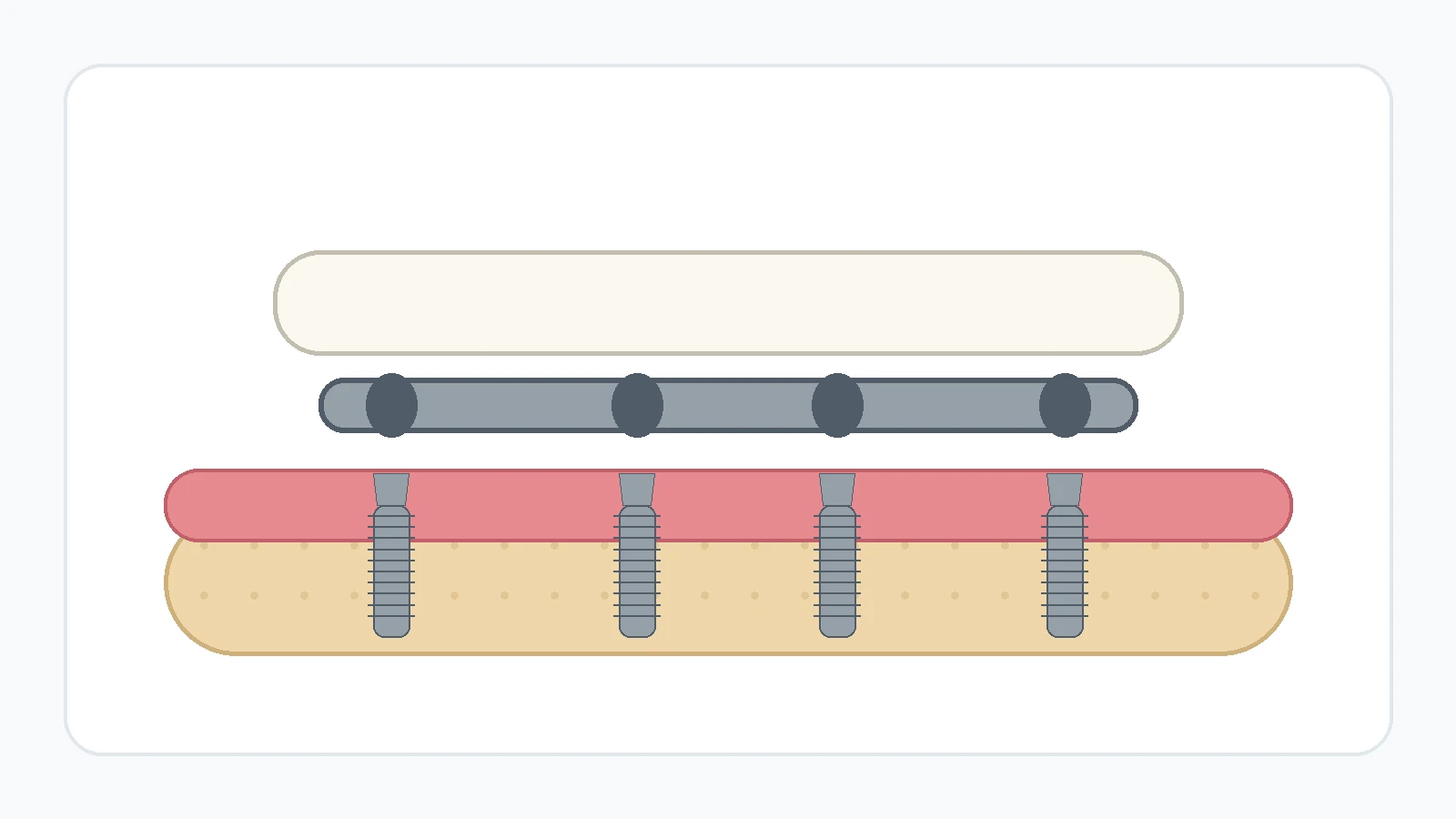
A titanium bar is a metal framework used in some implant-supported dental restorations.
In full-arch treatment, it may form part of the supporting structure inside or beneath the visible teeth.
Its exact role depends on the prosthetic design.
What is the bar connected to?
In a full-arch restoration, the implants are placed in the jawbone.
The restorative structure is then connected to those implants, often through abutments or multi-unit abutments.
A titanium bar or framework may form part of the bridge structure connecting the restoration across several implants.
Why is titanium used?
Titanium is widely used in implant dentistry because of its established use as a biocompatible engineering material and its favourable mechanical properties.
A titanium framework can provide rigidity and reinforcement within a prosthetic design.
That does not mean every full-arch restoration requires a titanium bar.
Is a titanium bar the same as the implants?
No.
The implants are the components placed into the jawbone.
The titanium bar is part of the prosthetic framework above the implants.
A patient can therefore have titanium implants without having a separate titanium bar in the final bridge.
Is it the same as a multi-unit abutment?
No.
A multi-unit abutment is a connector attached to an implant.
A titanium bar is a larger framework or reinforcing structure that may span multiple implants.
They can be used within the same restoration but perform different roles.
Is a titanium bar always visible?
Usually the structural bar is incorporated into or beneath the restorative teeth and gum-coloured material, depending on the design.
Patients generally see the finished prosthesis rather than the internal framework.
Does every zirconia bridge contain a titanium bar?
No.
Full-arch zirconia restorations can be designed in different ways.
Some may use titanium bases or a larger titanium framework. Other designs may rely primarily on the zirconia structure with different interfaces.
The phrase “zirconia bridge” therefore does not tell you automatically whether a titanium bar is present.
Why does it matter when comparing packages?
Dental Compass treats titanium-bar inclusion as a useful comparison point because clinic packages can describe full-arch restorations differently.
When comparing quotes, ask:
- whether a titanium bar or framework is included
- whether it is part of the temporary or final bridge
- whether it is included for one arch or both
- whether the quoted final-restoration price includes all framework and connection components
- whether a different framework design is being proposed instead
Do not assume that the absence of a titanium bar automatically makes a restoration inferior. The complete prosthetic design matters.
Can the bar itself need maintenance?
The complete restoration — including its screws, interfaces and framework — requires professional review and maintenance.
If a full-arch bridge becomes loose, fractures or changes in the way it feels when biting, the patient should contact the treating clinic rather than attempting to tighten or repair components themselves.
In simple terms
A titanium bar is a supporting or reinforcing framework used in some implant-supported restorations, particularly full-arch bridges.
It is separate from the implants themselves and is worth identifying clearly when comparing package inclusions.