

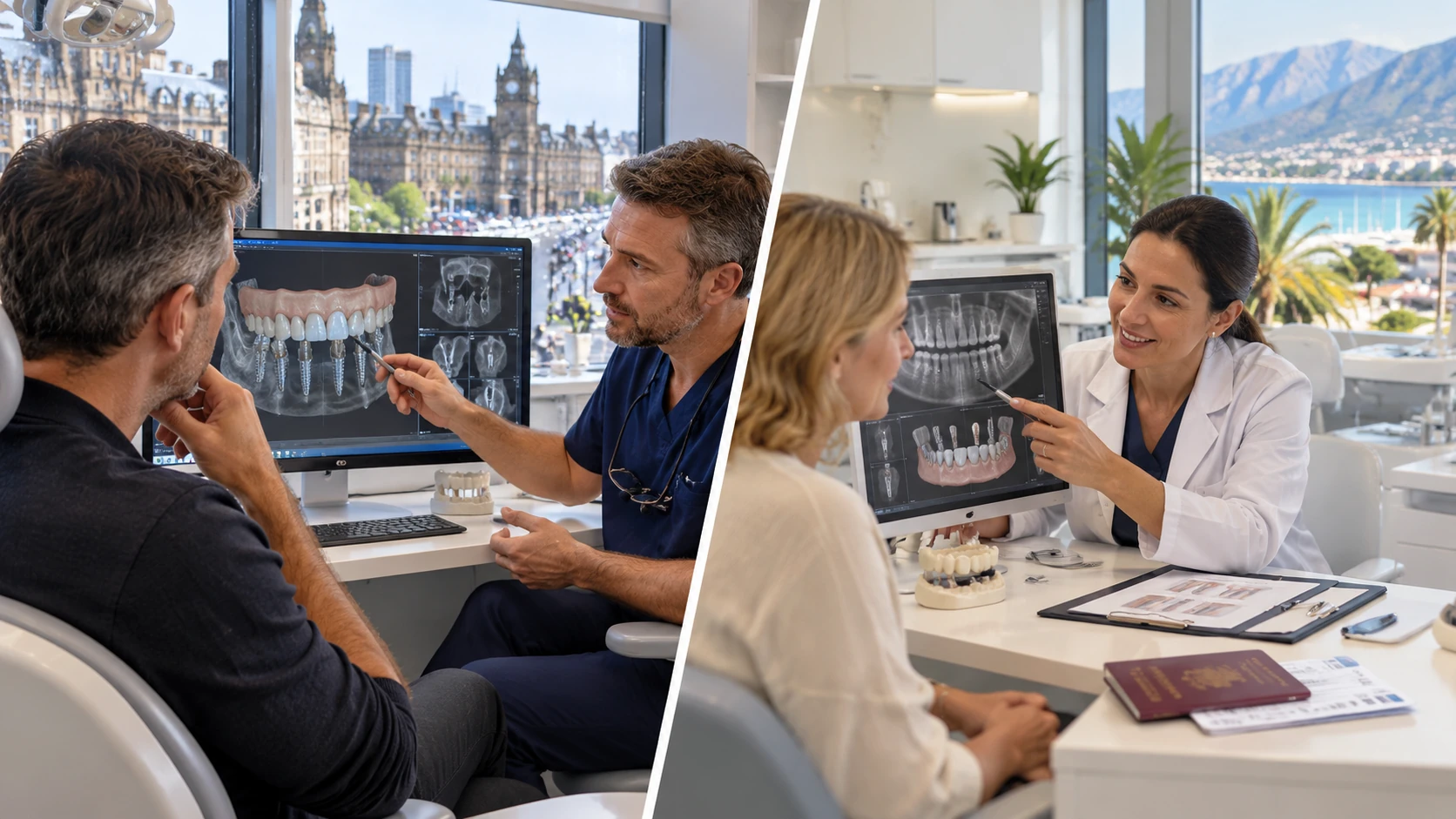
Patients often begin with a simple question: “Are dental implants cheaper abroad than in the UK?”
Price matters, but it is not enough to compare two headline figures.
A useful comparison asks whether the UK and overseas proposals describe the same diagnosis, same treatment design, same components, same temporary and final restoration, and the same level of aftercare.
Start with the diagnosis
Before comparing price, compare what each dentist says you actually need.
Differences can include:
- number of implants
- teeth to extract or retain
- bone grafting
- sinus procedures
- implant positions
- temporary restoration
- final bridge design
- number of treatment stages
Two quotes can differ because the treatment itself differs.
Compare the treating dentist
For either UK or overseas treatment, identify who is responsible for each stage.
Ask:
- who performs implant surgery
- who provides the restorative stage
- what qualifications they hold
- what professional registration applies
- whether the same dentist will see you during follow-up
In the UK, dentists must be registered with the General Dental Council to practise dentistry. Regulation abroad varies by country, so the GDC recommends researching the relevant regulator and the clinician before travelling.
Compare what the price includes
Break each quote into the same components:
- consultation
- OPG
- CBCT where clinically justified
- extractions
- grafting
- implants
- abutments or multi-unit components
- temporary teeth
- final bridge or crowns
- laboratory work
- medication
- follow-up
- repairs or adjustments
- night guard where recommended
If one quote includes more components, it is not directly comparable with a lower figure that excludes them.
Compare temporary teeth
For full-arch treatment, ask:
- fixed or removable
- same day or later
- connected to implants or not
- material
- expected period of use
- repair policy
The temporary stage can last for months and should not be treated as a minor extra.
Compare the final restoration
“Zirconia” or “fixed teeth” is not enough detail.
Ask:
- monolithic or layered
- one piece or segmented
- titanium bases or framework
- connection method
- number of try-ins
- bite and appearance approval
- maintenance requirements
Compare aftercare
This is one of the biggest practical differences between treatment close to home and treatment requiring international travel.
Ask both providers:
- who you contact if something feels wrong
- how urgent review is arranged
- what routine maintenance is expected
- what records you receive
- what guarantee terms apply
- who pays for remedial work
For overseas treatment, also ask whether a problem requires another flight and who pays for travel and accommodation. The GDC specifically advises patients to ask these questions before travelling.
Compare the complete financial cost
For overseas treatment, add:
- flights
- accommodation not included
- local travel
- travel insurance
- time away from work
- companion costs where relevant
- potential repeat trips
For UK treatment, also consider any separate consultation, imaging, laboratory and maintenance charges.
The comparison should be total expected cost, not just the advertised surgery price.
Regulation and complaints are different issues
UK dental professionals are regulated by the GDC.
If you travel abroad, the relevant regulatory and complaints system depends on the destination.
Find out before treatment:
- which body regulates the dentist
- whether registration is compulsory
- how complaints are handled
- what legal or consumer protections apply
- where disputes are resolved
Do not assume another country's system works like the UK's.
Insurance and healthcare cards
A GHIC or EHIC does not cover travelling abroad specifically for planned treatment.
NHS guidance advises appropriate travel insurance, and many standard travel policies exclude planned medical or dental treatment or complications related to it.
Check the policy wording before booking.
Travel convenience can affect aftercare
A clinic may provide excellent treatment overseas, but distance changes the logistics.
Consider:
- how quickly you could return
- flight availability
- cost of an urgent return
- whether a local dentist can obtain the implant components
- whether the overseas clinic will cooperate with a dentist at home
That does not make overseas treatment automatically worse. It is simply part of the comparison.
Do not compare countries as if every clinic is identical
The useful comparison is not:
UK clinic versus “Turkey”, “Poland” or “Hungary”.
It is:
one named dentist and treatment plan versus another named dentist and treatment plan.
Quality, communication, pricing, facilities and aftercare vary within every market.
In simple terms
Compare dental implants using the same headings on both sides:
dentist → diagnosis → treatment design → components → temporary teeth → final restoration → full cost → aftercare → regulation and travel.
Only then does a UK-versus-overseas price comparison become meaningful.