


The final teeth may mark the end of active treatment, but they do not mark the end of care.
Dental implants, the tissues around them and the restoration they support require daily cleaning, professional monitoring and access to repair when components wear or loosen. This remains true whether treatment was provided locally or abroad.
The practical challenge after overseas treatment is continuity: who will provide maintenance near home, what information they need and how the original clinic remains involved.
Implants are not maintenance-free
An implant replaces a tooth root but does not recreate every feature of a natural tooth. Plaque can accumulate around implant-supported restorations and inflammation can develop in the surrounding tissues.
Restorations and their components are also exposed to forces from eating, speaking, clenching and grinding. Crowns, bridges, dentures, screws, attachments and veneering materials can wear or require repair.
Maintenance therefore includes both biological health and mechanical function.
Daily cleaning must be individualised
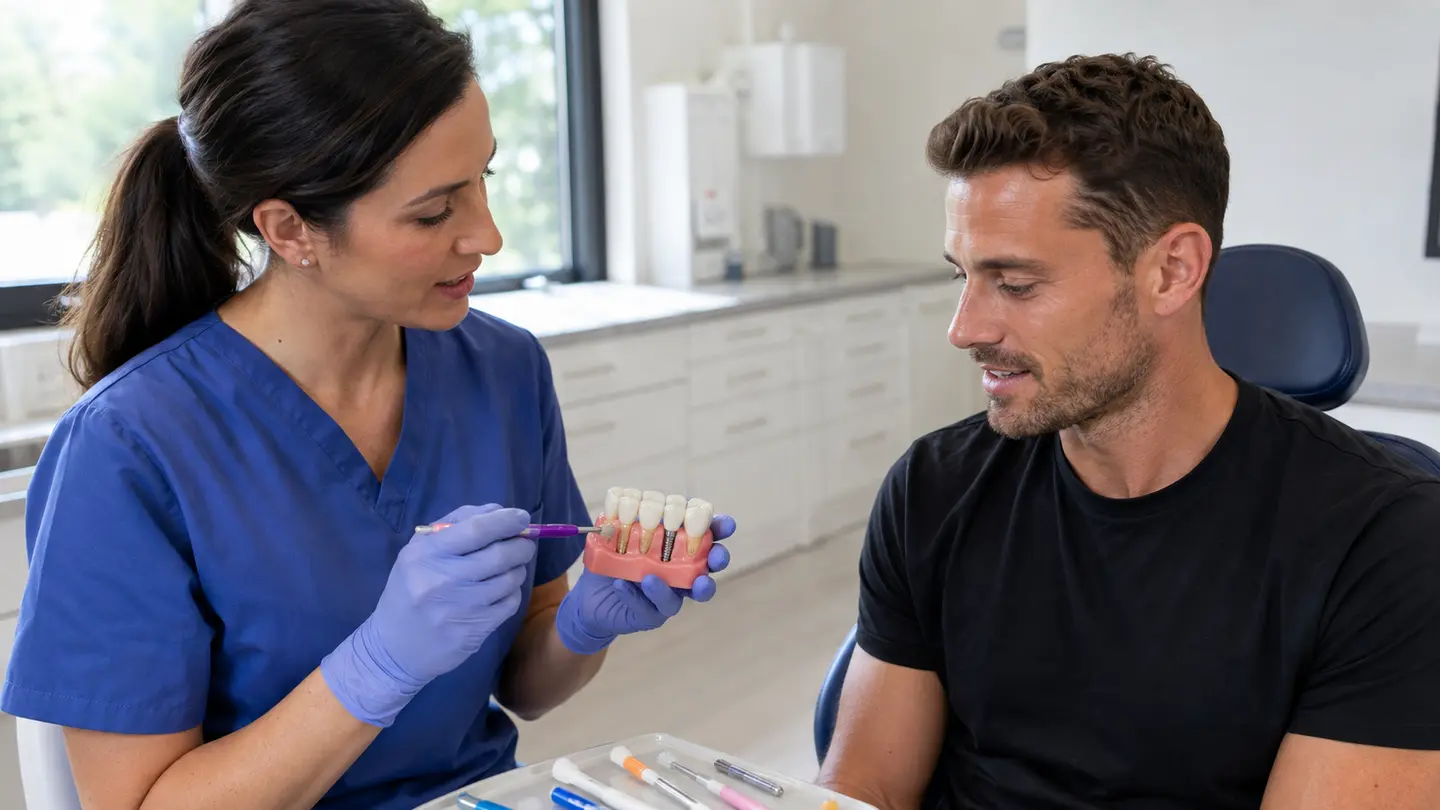
The correct technique depends on the restoration design, access beneath it, gum contours, dexterity and the rest of the mouth.
A dental professional may recommend a combination of toothbrushes, interdental brushes, flossing aids, irrigators or other tools. A fixed full-arch bridge can require different access from a single implant crown or removable overdenture.
Patients should be shown how to clean their own restoration and asked to demonstrate the technique before leaving the clinic. A generic product list is not a substitute for instruction.
Do not force an unsuitable tool beneath a restoration or assume that a method used by another patient is safe for a different design.
Cleanability is part of restorative quality
A restoration must do more than look attractive. The patient needs practical access to remove plaque and food debris without injuring the tissues.
If the patient cannot reach an area, repeatedly traps food or has persistent bleeding despite following instructions, professional review is needed. The answer may involve technique, tool selection, professional cleaning or assessment of the restoration's contours and fit.
Difficulty cleaning should be recorded before the patient returns home and reassessed after tissues have healed.
Professional maintenance is more than a polish

A maintenance appointment may include:
- discussion of symptoms and changes;
- review of medical history, medicines and risk factors;
- assessment of plaque control;
- examination of the tissues around implants and natural teeth;
- assessment of bleeding or other signs of inflammation;
- checking restoration stability, wear and damage;
- review of the bite where indicated;
- professional cleaning using appropriate methods;
- personalised reinforcement of home care;
- and radiographs when clinically justified.
The exact content and frequency should be based on professional assessment, not a universal timetable copied from a package. The European Federation of Periodontology's patient guidance recommends annual radiographs of implants to detect early bone loss, because peri-implantitis can start two to three years after placement in some patients; which imaging is appropriate for an individual remains a clinical decision.
Recall intervals depend on individual risk
Cambridge University Hospitals advises patients in its implant pathway that ongoing local review and professional cleaning may be needed every three to six months. UK NHS guidance on dental check-ups likewise explains that the time between check-ups can vary from 3 months to 2 years depending on oral health and risk.
These are not automatic schedules for every implant patient. A clinician may consider previous gum disease, smoking, general health, plaque control, restoration design, number of implants, past complications and ability to attend.
The patient should leave treatment with a recommended initial interval and know who will reassess it.
The gums around implants can become inflamed
The European Federation of Periodontology describes peri-implant mucositis as inflammation around an implant without supporting bone loss and peri-implantitis as inflammation associated with progressive supporting-bone loss.
Patients cannot diagnose these conditions themselves. Warning signs can include increased bleeding during cleaning, swelling, bad breath or an unpleasant taste, and loosening of an implant, bridge or denture.
Peri-implant disease may not always be obvious or painful. Regular review helps identify change earlier.
Natural teeth still matter
Patients with a mixture of implants and natural teeth need maintenance for both. Decay, gum disease, failing fillings, tooth wear and changes in the bite can affect the overall result.
Previous periodontitis is relevant because it is associated with increased risk around implants. The maintenance plan should therefore include the whole mouth rather than treating the implant bridge as an isolated product.
Smoking, health and medicines should be reviewed
Smoking is a recognised risk factor for implant complications. Changes in general health, medicines, dexterity or ability to clean can also change maintenance needs.
Tell the dental team about relevant changes. Advice should be personalised and coordinated with appropriate medical professionals where necessary.
The bite and restoration can change over time
Restorative materials can wear, opposing teeth can move and screws or attachments can loosen. A patient may notice clicking, movement, a changed bite, chipping, roughness or difficulty chewing.
These signs require professional assessment rather than repeated testing or home repair. Early attention may reduce further damage, but only an examination can establish the cause.
Patients who clench or grind should ask whether additional monitoring or a protective appliance is appropriate. Suitability must be decided individually.
Know who can service the implant system
Before treatment abroad, identify a dentist or hygienist willing to provide routine local maintenance. Confirm whether they can access the implant system and safely manage the restoration.
Provide:
- implant manufacturer, model, dimensions and positions;
- abutment and screw details;
- restoration and framework materials;
- retention method;
- relevant radiographs and scans;
- laboratory information;
- procedure dates;
- and the overseas clinic's professional contact.
A treatment passport summarises this information, while the complete clinical record should remain available.
Maintenance, repair and guarantee work are different
Routine examination and cleaning may be the patient's responsibility even when a restoration has a guarantee. Repair of a worn component, treatment of disease and replacement following an included event may each have different terms.
Ask the clinic to define:
- routine maintenance;
- adjustment;
- repair;
- complication management;
- and guarantee remedy.
A guarantee is a term of the clinic's own contract, and its scope depends on that contract and the applicable local law. A guarantee condition should not discourage necessary local assessment or urgent care.
When to contact a dental professional
Seek professional advice if there is new movement, fracture, worsening discomfort, swelling, bleeding, discharge, an unpleasant taste, persistent bad breath, difficulty cleaning or a significant change in the bite.
Use urgent or emergency routes for severe symptoms, uncontrolled bleeding, serious facial injury or swelling affecting breathing or swallowing.
Do not wait for the next overseas visit if a local assessment is clinically needed.
Questions for the long-term maintenance plan
- Who will provide maintenance near my home?
- When should my first local review occur?
- How will later recall intervals be decided?
- Which tools should I use for this exact restoration?
- Can I demonstrate that I can clean every required area?
- What should professional maintenance include?
- When might radiographs be clinically indicated?
- How will natural teeth and gums be monitored?
- What changes should I report promptly?
- Who can remove or service the restoration if required?
- Does the local provider have the component information?
- How are clenching, grinding or bite changes assessed?
- Which costs are maintenance rather than guarantee work?
- Will local care affect the overseas guarantee?
- How will the overseas and local clinicians communicate?
Maintenance should be planned before treatment

The best time to find a local maintenance provider is before implants are placed, not after a problem occurs.
A complete proposal should explain the restoration, cleanability, recommended reviews, professional cleaning, records, local-care arrangements and responsibility for future repairs. Those continuing requirements are part of the real treatment commitment and cost.
Important information
This article provides general educational information. It cannot prescribe cleaning tools, diagnose peri-implant disease or set an individual recall interval.
Follow advice from an appropriately qualified dental professional who has examined you and understands the restoration. Seek prompt assessment for concerning changes.
Dental Compass does not provide dental treatment, diagnosis or personalised maintenance plans.
Sources and further reading
- Cambridge University Hospitals NHS Foundation Trust, Dental implants in restorative dentistry (opens in a new tab) — long-term local review, professional cleaning and possible restorative wear or component replacement.
- European Federation of Periodontology, Peri-implant diseases (opens in a new tab) — definitions, warning signs and importance of regular professional review.
- European Federation of Periodontology, Peri-implant disease: Prevention (opens in a new tab) — home oral hygiene, regular professional monitoring, annual radiographs, and the added risk associated with previous periodontitis and smoking.
- British Society of Periodontology, Patient FAQs — Dental Implants (opens in a new tab) — maintenance, home cleaning, professional assessment, radiographs and recognised complications.
- NHS, Dental check-ups (opens in a new tab) — UK NHS guidance that the time between check-ups varies from 3 months to 2 years depending on oral health and risk.
- Guy's and St Thomas' NHS Foundation Trust, After having a dental implant (opens in a new tab) — personalised aftercare and long-term care of implants.