

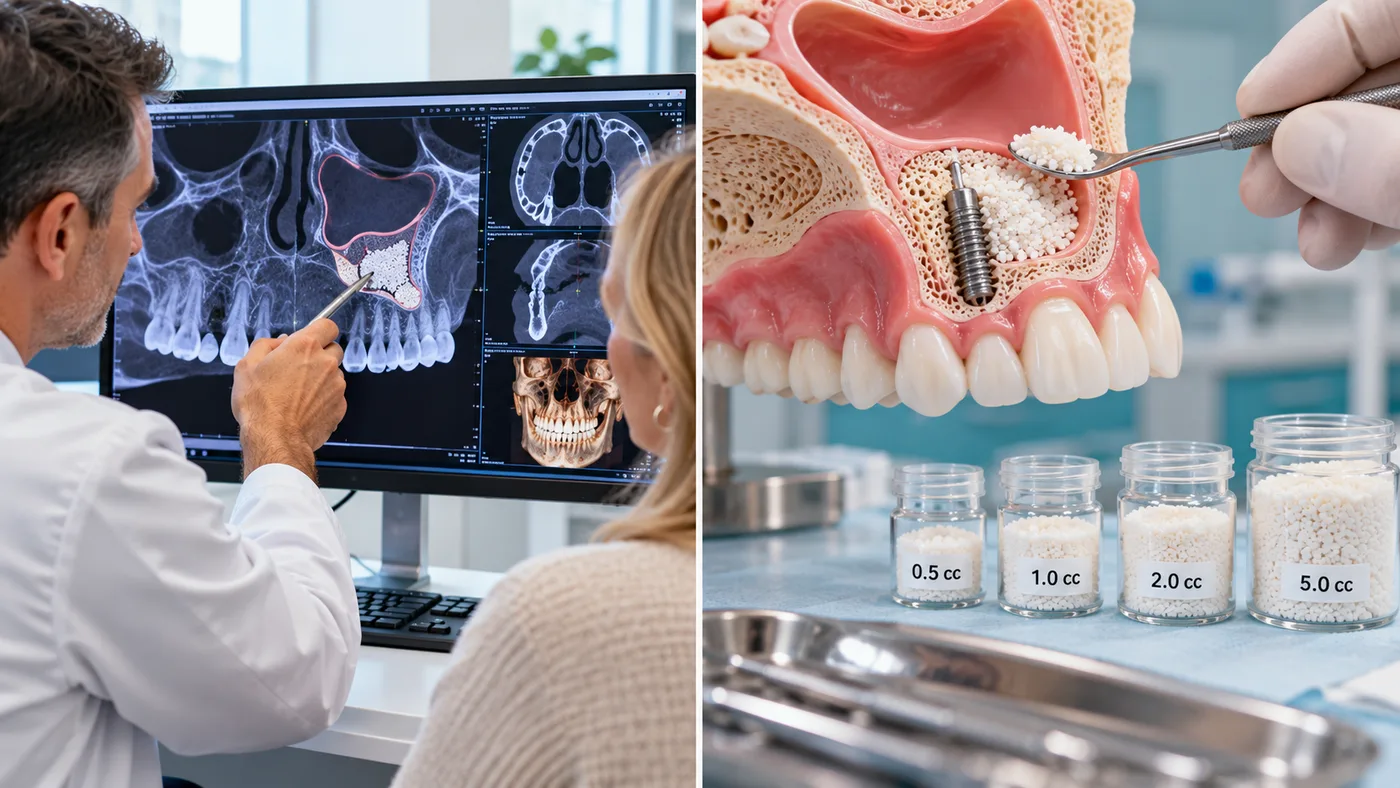
Bone grafting is one of the easiest parts of an implant quote to misunderstand. A clinic may say “bone graft included”, “0.5 cc included”, “£X per cc”, “grafting from £X”, or simply list grafting as a possible extra. Those descriptions are not equivalent.
The useful questions are: why might grafting be needed, what type of grafting is being discussed, how much graft material is included, how is it charged, what else is included with it, and what happens if more graft is required than the quote allows?
Why bone grafting may be used
Dental implants need enough suitable bone around them to allow the clinician to place the implant in the planned position. Bone grafting is used to increase or preserve bone where the existing ridge does not provide enough volume for the proposed treatment.
That does not mean every implant patient needs a graft. The need depends on the patient's anatomy, implant position, amount and shape of available bone, previous tooth loss and the treatment plan. A clinician may only be able to confirm this after examination and imaging.
Bone grafting can range from a small amount of particulate material placed around a local defect to much more extensive ridge or sinus augmentation.
“Bone graft” can mean very different procedures
Socket preservation
Graft material may be placed into or around an extraction socket to help preserve the ridge after a tooth is removed.
Local or guided bone regeneration
Particulate graft material may be placed around an implant or local bone defect and often protected with a membrane.
Ridge augmentation
A larger deficient section of jaw may need to be widened or rebuilt before, or sometimes at the same time as, implant placement.
Sinus augmentation
In the upper back jaw, graft material may be placed in relation to the maxillary sinus when additional vertical bone volume is required for the planned implant treatment.
Block or major grafting
Larger defects can require bone harvested from another area or another more extensive augmentation procedure. This is not the same service as adding a small amount of particulate graft around a single implant.
This is why a flat phrase such as “bone graft £250” is not enough to compare one clinic with another.
What does “cc” mean?
cc means cubic centimetre. One cc is the same volume as one millilitre (1 mL).
Bone-graft substitutes are commonly supplied in measured package volumes. Depending on the product, commercial packs are available in sizes such as:
- 0.5 cc
- 1.0 cc
- 2.0 cc
- larger volumes such as 4 or 5 cc
A clinic may therefore price graft material by the pack, by the volume used, or include a stated allowance in a treatment package.
Does 1 cc mean 1 cc of new bone?
No. A quoted volume such as 0.5 cc or 1 cc describes the volume of graft material supplied or allocated. It is not a promise that the patient will grow exactly that volume of new bone.
Graft particles form part of a biological healing process. The result depends on the type of graft, the defect, blood supply, the patient's healing, surgical technique and other factors.
How much graft material might be used?
There is no universal number of cc for “a bone graft”.
The amount depends on the three-dimensional size of the defect and the procedure being performed. A small local defect may require only a small quantity of particulate material. A larger ridge defect, sinus augmentation, several implant sites or treatment across an entire arch may require more material and sometimes multiple packs.
The amount can also be affected by:
- how many sites are being grafted;
- the width and height of the missing bone;
- whether the graft is used around an implant or before implant placement;
- whether a sinus procedure is involved;
- whether the material is mixed with the patient's own bone;
- particle size and handling characteristics of the product;
- whether a membrane or fixation is required.
This is why a patient should not try to calculate the “correct” number of cc themselves. The useful comparison is whether the clinic explains the allowance and what happens if the clinical requirement exceeds it.
Why two clinics can quote different numbers of cc
Two clinics may use different materials or techniques for the same broad treatment objective.
One clinician may use a particulate substitute alone, another may mix it with autogenous bone, and another may use a different augmentation technique. Products are also supplied in different particle sizes and package volumes.
So 1 cc from Clinic A is not automatically the same treatment as 1 cc from Clinic B.
The volume is useful commercial information, but it has to be read alongside the type of procedure and material.
How clinics may charge for bone grafting
There is no single charging model.
Per site
A fixed fee for grafting one implant or one extraction site.
Per procedure
A fixed fee for a defined procedure such as socket preservation, guided bone regeneration or sinus augmentation.
Per cc or per pack
The clinic may charge according to the amount of graft material opened or used — for example per 0.5 cc, 1 cc or another pack size.
Included allowance
A package may include a stated amount of graft material and charge only if more is required.
“From” price
A clinic may advertise grafting “from” a certain amount, with the final charge determined after examination and imaging.
Material plus surgical fee
Some quotes separate the biomaterial cost from the surgeon's procedure fee.
None of these methods is automatically better. What matters is whether the clinic explains the basis of the price.
The membrane may be a separate cost
Particulate grafting is often used with a barrier membrane in guided bone regeneration.
A quote should therefore make clear whether the following are included where relevant:
- graft material;
- membrane;
- fixation pins or screws;
- the surgical procedure;
- donor-site surgery if the patient's own bone is harvested;
- sedation or anaesthesia where applicable;
- follow-up appointments;
- additional imaging.
A quote that says only “1 cc bone graft” may still omit other parts of the augmentation procedure.
An example of why headline prices can mislead
These are fictional examples, not market prices:
Clinic A
- bone grafting: £300 per site
- graft material and membrane included
Clinic B
- graft material: £150 per cc
- membrane: £120
- surgical augmentation fee: separate
Clinic C
- implant package includes up to 1 cc of graft material
- additional material charged if more is required
All three may use the phrase “bone graft”, but they are not commercially equivalent.
Questions to ask the clinic
- What type of grafting do you think may be needed?
- Is that confirmed or only a possibility until I am examined?
- Is the price per site, per procedure, per cc, or per pack?
- How many cc are included in the quoted price?
- If more graft material is required, what is the additional cost?
- What graft material or source is proposed?
- Is the graft mixed with my own bone?
- Is a membrane included?
- Are fixation pins or screws included if required?
- Is sinus augmentation priced separately?
- Does the graft require an additional healing period or another visit?
- Will I receive an updated written treatment plan before proceeding if the requirement changes?
How Dental Compass should show grafting
A useful comparison should not reduce bone grafting to a single Yes/No field.
Where clinics provide the information, Dental Compass should distinguish:
- grafting included / not included / conditional;
- type of grafting;
- included volume in cc or mL;
- whether the allowance is per site, per arch or per treatment;
- material/source where declared;
- membrane included or separate;
- additional cc/package price;
- additional surgical fee;
- sinus augmentation separate or included;
- whether the final requirement is subject to examination or CBCT.
That allows patients to compare the commercial structure without Dental Compass pretending to decide how much grafting they clinically need.
The key point
A cc is a unit of graft-material volume, not a measure of how serious the case is and not a guarantee of how much new bone will form.
The important comparison is not simply “Which clinic gives more cc?”
It is: What procedure is proposed, what volume is included, what else is included with it, and what happens to the price if the clinical requirement changes?
Next step: Compare the graft allowance and charging basis alongside the clinic's imaging and treatment-plan assumptions before you compare the headline package price.