

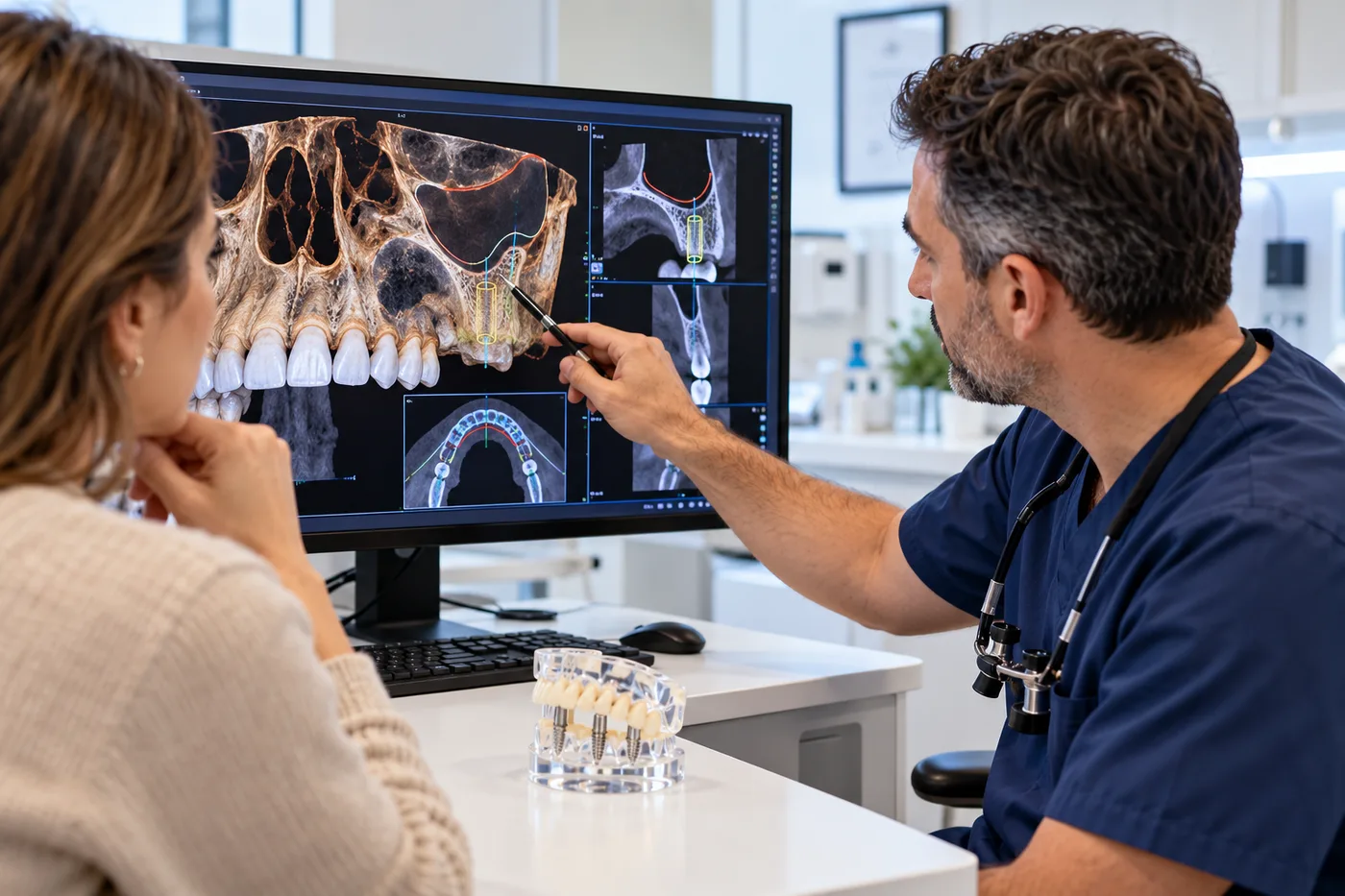
A CBCT scan is often one of the most important pieces of information used to plan dental implant treatment, but quotes frequently describe it badly.
One clinic may say “free scan”, another may include one CBCT in the package, another may charge for each scan, and another may only decide whether CBCT is needed after examination.
Those offers are not necessarily equivalent.
What is a CBCT scan?
CBCT stands for cone beam computed tomography.
Unlike a standard dental X-ray, CBCT produces three-dimensional information about the jaws and surrounding structures. It can help a clinician assess the amount and shape of bone and understand important anatomy around a proposed implant site.
For implant planning, that may include:
- bone height;
- bone width;
- the shape of the jaw ridge;
- the position of the maxillary sinus in the upper jaw;
- important nerve anatomy in the lower jaw;
- retained roots;
- existing implants;
- some areas of infection or bone loss;
- the relationship between proposed implant positions and neighbouring structures.
A CBCT is therefore much more than a marketing photograph of the teeth.
CBCT is not the same as a panoramic X-ray
A panoramic X-ray gives a broad two-dimensional overview of the teeth and jaws.
It can be extremely useful, but it cannot show bone width in the same way as a three-dimensional CBCT.
For some implant cases, especially complex or full-arch treatment, the clinician may need three-dimensional information before finalising the plan.
That does not mean every dental patient automatically needs CBCT. Imaging should be clinically justified rather than performed simply because a scanner is available.
Why the upper jaw matters
In the back of the upper jaw, the maxillary sinus is an important structure.
After teeth are lost, the available bone beneath the sinus can be limited. A CBCT can help the clinician assess the vertical bone available and whether the proposed implant position may require a different approach, including possible sinus augmentation.
This is one reason why a quote prepared before CBCT can legitimately change afterwards.
Why the lower jaw matters
In the lower jaw, clinicians need to understand the position of important nerve structures, particularly when planning implants in the posterior mandible.
Three-dimensional imaging can help the clinician assess the available bone in relation to those structures.
This does not mean CBCT “guarantees” safety. It is one part of diagnosis and planning.
What does a CBCT actually change?
A scan can affect decisions such as:
- how many implants are proposed;
- implant length or diameter;
- implant position and angulation;
- whether grafting may be needed;
- whether sinus augmentation may be needed;
- whether a proposed site should be avoided;
- whether retained roots or existing implants affect the plan;
- whether immediate implant placement is practical;
- whether a surgical guide is considered.
For a patient comparing quotes, that means a pre-CBCT estimate may not represent the final treatment plan.
How clinics may charge for CBCT
There is no single pricing model.
Included in the package
The treatment package may include one CBCT.
The key question is whether additional scans are included.
Charged separately
The clinic may charge a separate diagnostic fee for the scan.
That can be perfectly transparent if it is declared in advance.
“Free CBCT”
A clinic may advertise a free scan as part of consultation or treatment.
Ask whether:
- it is free even if you do not proceed;
- it is only free after paying a deposit;
- the scan report is included;
- you can receive a copy of the scan;
- later scans are chargeable.
Included up to a limit
Some packages may include one scan but charge for later scans.
Again, “CBCT included” is incomplete unless the limit is clear.
Can more than one CBCT be used during implant treatment?
Yes, depending on the clinical situation and treatment pathway.
A patient may have imaging:
- before implant placement;
- after implant placement in selected circumstances;
- during a staged treatment pathway;
- before a later surgical stage;
- before the final restoration if the clinician considers further imaging necessary.
That does not mean four scans, three scans or even two scans are automatically required for every patient.
The important principle is that each exposure should have a clinical reason.
Why repeated scans matter commercially
For overseas treatment, repeat imaging can create an unexpected extra cost.
Imagine:
Clinic A
- initial CBCT included;
- any later CBCT £100 each.
Clinic B
- all clinically required CBCT scans during the planned two-visit treatment included.
Clinic C
- “free CBCT” at consultation;
- later surgical imaging charged separately.
The headline phrase “CBCT included” does not tell you which offer is better.
Does the clinic give you the scan?
Ask whether you can receive:
- the scan files;
- exported images;
- a written radiology report where one is produced;
- information needed for another clinician to review the imaging.
CBCT data may be useful if you later require another opinion or aftercare elsewhere.
A screenshot of the scan is not the same as having the underlying imaging data.
What about radiation?
CBCT uses ionising radiation, so scans should not be treated casually.
The appropriate field of view and scan settings depend on the clinical question.
Patients do not need to choose scan parameters themselves, but they can reasonably ask why a scan is needed if repeated imaging is proposed.
More scanning is not automatically better treatment.
CBCT and surgical guides
CBCT data may be combined with digital dental scans when planning guided implant surgery.
If a clinic advertises “digital implant planning” or a “surgical guide”, ask whether:
- CBCT is included;
- intraoral scanning is included;
- guide design is included;
- guide manufacture is included;
- the guide is used routinely or only in selected cases.
These can be separate commercial items.
Questions to ask the clinic
- Is CBCT included in my quoted price?
- How many CBCT scans are included?
- When do you expect each scan to be taken?
- What would make an additional scan necessary?
- What is the charge for another scan?
- Is the scan reviewed by the treating clinician?
- Is a separate radiology report produced?
- Can I have a copy of my scan data?
- Is intraoral scanning also required?
- Is surgical-guide planning included?
- Could the treatment price change after CBCT?
- If it changes, will I receive a new written plan before treatment?
How Dental Compass should compare CBCT
A useful comparison should distinguish:
- CBCT included / excluded / conditional;
- number included;
- additional scan price;
- consultation scan versus treatment scan;
- whether scan data can be supplied to the patient;
- whether a report is included where applicable;
- digital scan included;
- surgical guide included or separate;
- whether the final treatment plan is confirmed only after CBCT.
The key point
“CBCT included” is not enough information.
The important questions are how many scans are included, when they are expected, whether additional scans cost extra, and whether the treatment plan can change after the three-dimensional assessment.
Next step: When comparing implant quotes, put CBCT beside grafting, extractions and temporary teeth rather than treating it as a minor free extra.