

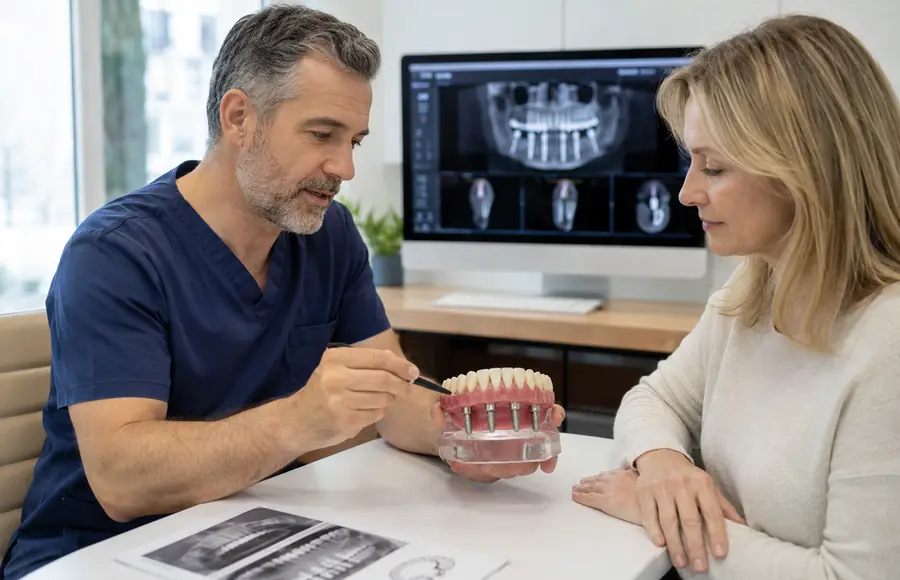
An All-on-4 package can look simple on a clinic website: four implants, a new set of teeth and one headline price.
In reality, a full-arch implant treatment involves much more than four implant fixtures.
A meaningful package comparison should show what happens before surgery, what is fitted on the day, what happens during healing, what the final restoration is made from, which laboratory and surgical components are included, and which items can still create extra charges.
The phrase “All-on-4 package” is not a complete treatment specification.
First: what does All-on-4 actually mean?
All-on-4® is the name of a full-arch treatment concept originally associated with Nobel Biocare. The original concept uses four implants to support a fixed full-arch prosthesis, typically with two anterior implants placed more vertically and two posterior implants angled to make use of available bone and avoid important anatomical structures.
The term is now also used more loosely in dental advertising to describe full-arch treatment supported by four implants.
That means two clinics can both advertise “All-on-4” while using different:
- implant systems;
- implant positions;
- temporary restorations;
- final bridge materials;
- laboratory workflows;
- prosthetic components;
- aftercare arrangements.
The name alone does not tell you what the package contains.
Four implants should mean four implants per treated arch
A genuine four-implant full-arch plan normally means four implants supporting one treated arch.
If both upper and lower arches are treated, that normally means four implants in the upper arch and four in the lower — eight implants in total.
The quote should make this explicit.
Ask:
- Is the price per arch or for both arches?
- How many implants are included per arch?
- Is a different number of implants possible after assessment?
- What happens to the price if the treatment plan changes to five or six implants?
Is the implant brand and system included?
The quote should identify the implant system where the clinic is willing to declare it.
The important issue is not simply whether the brand is famous. It is knowing what is actually being used and whether future replacement components can be identified.
Ask whether the package includes:
- implant fixtures;
- cover or healing components where required;
- multi-unit abutments;
- prosthetic screws;
- temporary cylinders;
- final prosthetic components.
A package that lists “4 implants” may still charge separately for components needed to connect the bridge to them.
Multi-unit abutments can be a significant hidden component
Full-arch implant restorations often use prosthetic abutments between the implants and the bridge.
These can help manage implant angulation and provide the restorative platform.
They should not be assumed to be free just because the implant fixtures are included.
Ask:
“Are all multi-unit abutments and prosthetic components included in the package price?”
Consultation and treatment planning
A full-arch package should make clear what diagnostic and planning work is included.
That may include:
- remote assessment;
- in-person examination;
- clinical photographs;
- panoramic X-ray;
- CBCT;
- digital intraoral scan;
- impressions;
- bite records;
- digital smile/prosthetic planning;
- surgical planning.
If the package says “free consultation”, establish whether the imaging and planning required to make the treatment decision are also included.
CBCT: one scan or all clinically required scans?
A CBCT scan may be used to assess three-dimensional bone anatomy and relevant structures.
Some clinics include only the first scan.
Others may include the scans required within the planned treatment pathway.
Ask:
- how many CBCT scans are included;
- whether later scans are charged;
- whether the scan is included if you decide not to proceed;
- whether you can receive a copy of the data.
For some patients the treatment plan can change after CBCT.
The package should explain what happens to the price if that occurs.
Extractions: “included” needs a definition
Full-arch patients may require removal of remaining teeth, but not every natural tooth should be assumed to require extraction simply because an implant package has been chosen.
The quote should state:
- how many extractions are included;
- whether all planned extractions are included;
- whether surgical extractions are included;
- whether retained roots are included;
- whether impacted teeth are included;
- whether treatment of infection creates an additional charge.
The clinic should also explain why each remaining tooth is being removed rather than treating “more extractions included” as an added benefit.
Bone grafting: included, limited or separate?
One of the largest areas for package confusion is bone grafting.
“All-on-4” is often associated with treatment strategies intended to make use of available bone and reduce the need for grafting, but that does not mean every patient can be treated without grafting.
The actual requirement depends on the anatomy and treatment plan.
Ask whether the package includes:
- no grafting;
- minor grafting around implant sites;
- a stated allowance such as 0.5 cc, 1 cc or another volume;
- grafting per site;
- membrane;
- fixation materials;
- sinus augmentation.
If the package includes a graft allowance, establish what happens when that allowance is exceeded.
Sinus augmentation is not the same as ordinary “bone graft included”
In the posterior upper jaw, limited bone beneath the maxillary sinus can affect implant planning.
A sinus augmentation procedure can be materially different from placing a small amount of particulate graft around an implant.
A package that says “bone graft included” should therefore clarify whether sinus augmentation is included, excluded or separately priced.
Temporary teeth: fixed or removable false teeth?
This should never be reduced to “temporary teeth included”.
For some patients, the temporary restoration is a fixed provisional bridge.
For others, the healing-period solution may be a removable denture — ordinary false teeth — while the implants integrate.
Immediate fixed provisional teeth normally depend on the clinical plan and adequate implant stability.
Ask:
- fixed or removable?
- fitted on the day of surgery or later?
- what material?
- one temporary restoration per arch?
- what happens if the implants are not stable enough for immediate loading?
- is a backup denture included?
- are repairs and relines included?
“Same-day teeth” should not be interpreted as an unconditional guarantee for every patient.
What is the temporary bridge made from?
Temporary fixed full-arch restorations are often made from provisional materials such as PMMA or acrylic-based materials.
They are intended for the healing phase and may require adjustment or repair.
The package should explain:
- temporary material;
- expected duration;
- repair policy;
- replacement cost;
- dietary restrictions;
- support if it breaks after the patient returns home.
What exactly are the final teeth?
“Final teeth included” is too vague.
Ask what the definitive restoration actually is.
Possible descriptions include:
- acrylic hybrid bridge;
- PMMA-type restoration;
- composite-based restoration;
- zirconia full-arch bridge;
- zirconia combined with another framework or substructure.
The package should also identify whether the final restoration is:
- one-piece or segmented;
- screw-retained;
- removable only by a clinician;
- supported by a separate framework or bar.
Is a titanium bar or framework included?
Some full-arch prosthetic designs use a titanium bar or framework.
Other valid designs may use a different construction.
If a titanium framework is part of the proposed restoration, ask:
- is it included?
- is the price per arch?
- is there one framework for each treated arch?
- does it belong to the temporary or final restoration?
- is the laboratory design and manufacture included?
The phrase “zirconia teeth included” does not automatically tell you whether a separate titanium framework is also included.
Laboratory work
Full-arch treatment usually involves significant laboratory work.
A package should make clear whether it includes:
- temporary restoration manufacture;
- digital design;
- final impressions/scans;
- try-in stages;
- final bridge manufacture;
- shade selection;
- adjustments;
- remake caused by laboratory error;
- additional laboratory work if the treatment plan changes.
A low surgical price can become much more expensive if key laboratory stages are separate.
Number of visits and treatment stages
A package should state the expected treatment journey.
For example:
First visit
- examination;
- CBCT;
- extractions;
- implant surgery;
- possible grafting;
- temporary teeth.
Healing period
- remote or local review;
- adjustments if required.
Second visit
- assessment of healing;
- final records;
- try-in;
- fitting of definitive bridge.
Some treatments require additional stages.
The clinic should not imply that every patient follows exactly the same timetable.
How long is the healing period?
There is no single universal healing period for every patient.
Timing can depend on:
- implant stability;
- bone quality;
- grafting;
- arch treated;
- medical factors;
- clinician's loading protocol;
- response to healing.
The package should give an expected range but also explain what happens if healing takes longer.
For overseas patients, delayed healing can mean another trip.
Are medications included?
Check whether the package includes or supplies:
- prescribed antibiotics where clinically indicated;
- pain relief;
- mouth rinse;
- other post-operative medication.
Medication practice varies, and medication should be clinically prescribed rather than treated as a marketing freebie.
The commercial question is simply whether there is an additional cost.
Is sedation included?
Many full-arch procedures can be carried out under local anaesthesia, but some patients may use sedation depending on the clinic and clinical circumstances.
If sedation is offered, establish:
- type of sedation;
- whether it is optional or recommended;
- whether it is included;
- anaesthetist or sedation-provider fee;
- additional monitoring charges.
Is a night guard included?
A protective night guard may be recommended for some full-arch patients, particularly where grinding or clenching is a concern.
Ask:
- whether one is included;
- whether two are supplied when both arches are treated;
- replacement price;
- whether warranty terms require its use.
Hotel: how many nights?
“Hotel included” should specify:
- number of nights;
- hotel category or named hotel where applicable;
- room type;
- breakfast;
- companion policy;
- additional-night cost;
- what happens if treatment is delayed.
Do not compare “hotel included” without comparing the number of nights.
Transfers: exactly which journeys?
A transfer package may include:
- airport to hotel;
- hotel to clinic;
- clinic to hotel;
- hotel to airport.
But some packages only include airport transfers.
Ask whether clinic transport is provided for every required appointment and whether a companion is included.
Flights are usually a separate issue
Unless a clinic explicitly states otherwise, do not assume flights are included merely because accommodation and transfers are included.
For Dental Compass comparisons, flights should be shown separately from clinic treatment inclusions.
Aftercare after you return home
This is one of the most important package components and one of the least visible in headline advertising.
Ask:
- who you contact with a problem;
- response hours;
- remote review arrangements;
- whether the clinic has UK/local partners;
- what happens if temporary teeth break;
- what happens if a screw loosens;
- who pays for local assessment;
- whether return travel is ever covered;
- how long aftercare lasts.
What does the warranty cover?
“Lifetime warranty” or “guaranteed implants” is not enough.
Ask whether the written warranty separately covers:
- implant fixture;
- abutments;
- screws;
- temporary bridge;
- final bridge;
- zirconia;
- acrylic/composite parts;
- titanium framework;
- laboratory workmanship.
Also check conditions and exclusions.
Maintenance is part of the real cost
Implant-supported full-arch restorations require ongoing professional maintenance and home care.
The package price usually covers treatment, not lifelong maintenance.
Ask:
- recommended review frequency;
- hygiene appointments;
- professional cleaning requirements;
- whether the bridge needs periodic removal;
- likely maintenance costs;
- whether maintenance affects warranty.
Deposits and staged payments
Ask:
- deposit amount;
- when it becomes non-refundable;
- whether it is deducted from treatment;
- payment due on the first visit;
- payment due on the second visit;
- what happens if the final plan changes;
- what happens if treatment cannot proceed as expected.
Avoid confusing a deposit with confirmation of a final clinical treatment plan.
“All inclusive” should have an exclusions list
A genuinely transparent package should be able to tell you what is not included.
Possible exclusions include:
- major bone grafting;
- sinus augmentation;
- complex surgical extraction;
- IV sedation;
- additional CBCT;
- unexpected infection treatment;
- extra hotel nights;
- additional flights;
- temporary repairs after returning home;
- local dentist fees;
- extra treatment visits.
An exclusions list can be more valuable than the phrase “all inclusive”.
“Included” may actually mean “included up to…”
Pay attention to caps such as:
- up to 4 extractions;
- up to 1 cc graft;
- one CBCT;
- one temporary bridge;
- five hotel nights;
- one repair.
A capped inclusion is not unlimited.
Dental Compass should store the cap, not just a Yes/No tick.
Example: two £5,000 packages
Package A
- 4 implants;
- multi-unit abutments;
- CBCT;
- all planned extractions;
- up to 1 cc graft;
- membrane;
- fixed PMMA temporary bridge if stability allows;
- removable backup denture;
- final zirconia bridge;
- titanium framework;
- 5 hotel nights;
- all clinic transfers;
- night guard;
- written aftercare.
Package B
- 4 implant fixtures;
- temporary removable denture;
- final bridge.
Extra:
- CBCT;
- abutments;
- extractions;
- grafting;
- titanium framework;
- hotel;
- transfers.
Both may be advertised at £5,000, but they are not commercially equivalent.
These figures are illustrative, not market prices.
Questions to ask before booking
- Is this price per arch or for both arches?
- Exactly how many implants are included?
- Which implant system is proposed?
- Are all abutments and prosthetic components included?
- How many CBCT scans are included?
- Which extractions are included?
- Are surgical extractions included?
- Is grafting included?
- How many cc of graft are included?
- Are membranes included?
- Is sinus augmentation included?
- Are temporary teeth fixed or removable false teeth?
- What happens if immediate fixed teeth are not possible?
- What is the temporary material?
- What is the final restoration made from?
- Is a titanium bar/framework used and included?
- Is the laboratory work included?
- How many treatment visits are expected?
- What happens if healing requires another trip?
- Are medications included?
- Is sedation extra?
- Is a night guard included?
- How many hotel nights are included?
- Which transfers are included?
- What aftercare is provided at home?
- What exactly does the warranty cover?
- What regular maintenance will I need?
- What can increase the quoted price?
- What is specifically excluded?
- When will I receive the final written treatment plan and final price?
How Dental Compass should compare All-on-4 packages
A useful comparison should show separate fields for:
- price per arch / both arches;
- implant count;
- implant system;
- abutments/components;
- CBCT count;
- extractions and caps;
- graft allowance in cc;
- membrane;
- sinus augmentation;
- temporary restoration type;
- fixed/removable;
- temporary material;
- final restoration material;
- titanium framework;
- laboratory work;
- expected visits;
- medications;
- sedation;
- night guard;
- hotel nights;
- transfers;
- aftercare;
- warranty;
- maintenance requirements;
- conditional extras;
- exclusions.
The key point
An All-on-4 package is not just four implants and a bridge.
The real package is the complete pathway from diagnosis to temporary teeth, healing, final restoration and aftercare.
The best-value package is not necessarily the one with the lowest headline number.
It is the one where you can clearly see what is included, what is capped, what is conditional, what is excluded, and what you may still have to pay for.
Next step: Compare every All-on-4 quote using the same fields before deciding which headline price is actually cheaper.